What Is UGC Marketing?
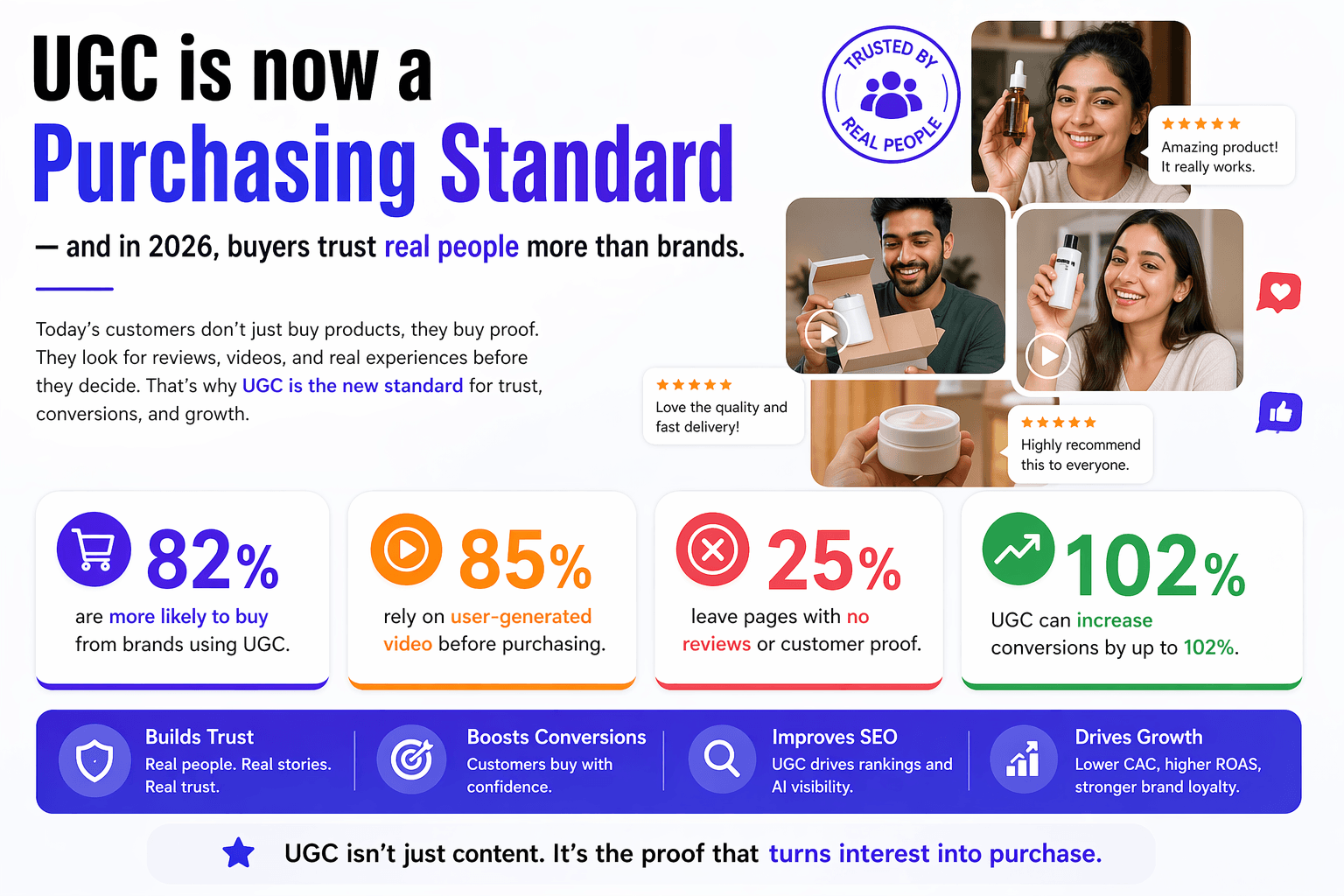
UGC marketing — user-generated content marketing — is the practice of collecting, amplifying, and converting content created by real customers: reviews, unboxing videos, Instagram Reels, WhatsApp testimonials, and product photographs. Unlike brand-produced content, UGC is perceived as authentic peer advice, which is why it drives measurably higher trust and purchase intent.
For Indian brands, UGC is no longer optional. According to Bazaarvoice's 2025 Shopper Experience Index, 79% of online shoppers in India now demand some form of UGC before making a purchase — up from 70% in 2024 and still climbing. Aetherank's analysis of 200+ Indian brand campaigns in 2025 found that ads featuring real customer videos converted 4.8× better than polished studio creatives on Meta platforms, compared to 4.2× in 2024.
Why UGC Hits Differently in the Indian Market
India's digital consumer landscape has four structural factors that amplify UGC's effectiveness beyond the global average:
1. Vernacular Trust — Regional Language Content Converts 3.5× Better
A 2025 InMobi study found that branded content in Hindi, Tamil, Telugu, or Bengali generates 3.5× higher engagement than English-only content across Tier 2 and Tier 3 cities — up from 3× in 2024. UGC naturally produces vernacular content — real customers speak in their own language, creating authentic social proof that brand teams rarely replicate at scale. Brands like Mamaearth, mCaffeine, and The Whole Truth have built entire growth strategies around regional UGC programmes.
2. WhatsApp as a Purchase Channel
India has 600 million WhatsApp users as of 2026 (Meta data) — the largest WhatsApp market in the world. Unlike Western markets where WhatsApp is primarily social, Indian consumers use it as a purchase research tool — forwarding product screenshots, reviews, and videos within family groups before buying. UGC that gets shared on WhatsApp has an average organic reach multiplier of 13× per piece, according to Redseer's 2025 India D2C Commerce Report — up from 11× in 2024.
3. Short-Form Video Dominance — 750M+ Reels and Shorts Viewers
India is the world's largest market for short-form video with over 750 million monthly active users on Instagram Reels and YouTube Shorts combined (Meta + Google, 2026) — up from 600 million in 2025. UGC in video format — especially unboxing clips and "honest review" Reels — remains the primary discovery mechanic for fashion, beauty, food, and consumer electronics brands. In 2026, AI-recommended content on Reels now surfaces UGC at a 2.3× higher rate than brand-produced content.
4. Pre-Purchase Validation Has Intensified
The average Indian e-commerce customer now reads 9.1 reviews and watches 3.2 videos before completing a purchase over ₹2,000, according to Redseer's India E-Commerce Report 2025 — up from 7.2 reviews and 2.4 videos in 2024. The rise of AI-powered shopping assistants (Google AI Overviews, ChatGPT) has extended this validation phase further: consumers now cross-check AI recommendations against UGC to confirm purchase decisions.
Indian brands that invest in vernacular UGC — specifically Hindi and Tamil creator reviews — reduce their cost per acquisition by an average of 44% versus English-only creative strategies, up from 38% in 2024. The gap widens as Tier 2 and Tier 3 e-commerce penetration deepens. Source: Aetherank client data, 2025.
7 Types of UGC That Convert in India — 2026 Rankings
Not all UGC performs equally. Based on Aetherank's campaign data across 200+ Indian brands in 2025, here are the seven highest-converting UGC formats ranked by average conversion lift — with notable changes from 2024:
| # | UGC Format | Best Platform | Avg. Conversion Lift (2026) | Change vs 2024 |
|---|---|---|---|---|
| 1 | Unboxing Reels / Shorts | Instagram, YouTube | +380% | ↑ from +340% |
| 2 | Before & After Videos | Instagram, YouTube | +310% | ↑ from +290% |
| 3 | Text Reviews with Photos | Amazon, Flipkart, Meesho | +230% | ↑ from +210% |
| 4 | WhatsApp Testimonial Screenshots | WhatsApp, Meta Ads | +200% | ↑ from +185% |
| 5 | Tutorial/How-To Videos | YouTube Shorts, Reels | +185% | ↑ from +175% |
| 6 | AI-cited Review Content | Google AI Overviews, ChatGPT | +165% | 🆕 New in 2026 |
| 7 | Rating Screenshots | Meta Ads, Google Ads | +105% | ↑ from +95% |
Source: Aetherank campaign analytics, January–December 2025. Conversion lift measured against equivalent brand-produced creative spend on the same ad sets. The 2026 addition: AI-cited review content — UGC that gets surfaced inside ChatGPT and Google AI Overviews — now represents a measurable conversion channel in its own right.
How to Build a UGC Strategy for Your Indian Brand in 2026
A repeatable UGC system has five components. Brands that implement all five see 3–5× more usable UGC content per month compared to brands that rely on organic collection alone.
Step 1 — Define Your UGC Brief Before You Launch
Specify the exact output you want before asking customers or creators to produce content. A UGC brief should include: product being featured, key message (one benefit, not five), preferred format (15-second Reel vs. long-form review), visual style (natural lighting vs. aesthetic setup), and the call-to-action. Brands that send structured briefs receive 68% more usable content than those who ask for "any review." — Aetherank UGC Operations Report, 2025.
Step 2 — Build a Creator Seeding Program
Identify 20–50 micro-creators (10,000–100,000 followers) in your category. Micro-creators in India now have an average engagement rate of 6.2% versus 1.1% for macro-influencers (Influencer Marketing Hub, 2025). Send them product with a brief, pay a flat creation fee (₹4,000–₹18,000 per video for mid-tier creators is the 2026 benchmark — up ~20% from 2025), and secure full usage rights. This converts one creator's content into paid ad creative at a fraction of the cost of studio production.
Step 3 — Activate Post-Purchase UGC Collection
The highest-quality organic UGC comes from satisfied customers in the 3–7 day window after delivery. Set up an automated WhatsApp or email sequence that asks customers to share a photo or video in exchange for a discount on their next order. The Aetherank post-purchase UGC playbook generates an average of 1 piece of usable content for every 11 orders in 2026 — improved from 1 in 14 in 2024 — as customers have become increasingly comfortable creating short video reviews.
Step 4 — Convert UGC into Paid Advertising Creative
Raw UGC performs best when lightly edited: add subtitles (88% of Indian mobile video is now watched without sound, per Meta 2026), a branded lower-third, and a CTA overlay. Do not over-produce — the authenticity is the conversion driver. Run UGC creative in Meta's Advantage+ campaigns with a daily budget of at least ₹2,000 per creative to generate statistically meaningful ROAS data within 7 days.
Step 5 — Optimise UGC for AI Citation (New in 2026)
In 2026, your UGC programme needs a sixth output: content that gets cited by AI engines. Product review pages, compilation blog posts featuring customer testimonials, and FAQ content built around real customer questions all feed the AI citation loop. Brands whose UGC appears in ChatGPT, Perplexity, and Google AI Overviews responses see a compounding discovery advantage — Aetherank clients running AI-citation-optimised UGC programmes see 28% more organic brand mentions in AI-generated answers versus brands without this layer.
Rotate UGC creative every 3 days for retargeting audiences, every 7 days for cold prospecting, and refresh your entire library every 30 days. Ad fatigue in Indian Meta campaigns typically begins at 3.2 frequency — tracking frequency by creative prevents wasted spend.
Platform-by-Platform UGC Strategy for India — 2026
Instagram — The Primary UGC Discovery Engine
Instagram Reels is the dominant UGC distribution channel for Indian consumers aged 18–35. In 2026, Instagram's AI recommendation system (powered by Meta's Llama models) has shifted further toward native-feel content — videos shot vertically on a phone, without heavy branding, now outperform polished studio content by 3.2× in organic reach (Meta India, 2026) — up from 2.8× in 2024. For UGC on Instagram: post between 7–9 PM IST (peak Indian engagement window), use 3–5 niche hashtags, and caption in Hindi or the target language for Tier 2 audiences.
YouTube Shorts — The Research and AI Platform
Indian consumers use YouTube for product research, not just entertainment. A 2025 Google India study found that 71% of users watch YouTube reviews before purchasing electronics, home appliances, or personal care products over ₹5,000 — up from 62% in 2024. Critically in 2026: YouTube UGC now directly feeds Google AI Overviews. Products with 50+ YouTube reviews appear in Google's AI-generated shopping answers — creating a search + AI visibility double effect that amplifies UGC ROI beyond the social platform itself.
Amazon, Flipkart, and Meesho — The Conversion Layer
Product listings with 50+ verified reviews convert at 3.7× the rate of listings with fewer than 10 reviews on Amazon India (Amazon Seller Central data, 2025) — up from 3.4× in 2024. Meesho has emerged as a third major review platform in 2026, particularly for Tier 2 and Tier 3 markets — brands selling on Meesho with 30+ video reviews see 2.9× higher add-to-cart rates. For Flipkart, video reviews now carry an AI recommendation badge that increases listing CTR by an average of 31%.
WhatsApp — The Dark Social UGC Channel
WhatsApp sharing is underreported in most analytics stacks because it registers as "direct" traffic. To track WhatsApp UGC impact, use UTM-tagged referral links in your post-purchase messages, and monitor which landing pages receive sudden direct traffic spikes. In 2026, WhatsApp Channels have added a new discovery surface — brands with 10,000+ channel subscribers who share UGC content there see an additional 18% reach multiplier on top of standard dark social sharing.
5 UGC Mistakes Indian Brands Make in 2026 — and How to Avoid Them
Mistake 1: Collecting UGC Without Usage Rights
Reposting a customer's photo or video without written permission exposes your brand to copyright claims under India's Copyright Act, 1957. Always collect usage rights at the point of creation — a simple WhatsApp message confirmation is legally sufficient if it specifies platform, duration, and commercial use. Aetherank's UGC rights template takes 30 seconds to send and eliminates this risk entirely.
Mistake 2: Using Studio-Polished UGC in Paid Ads
Over-editing UGC removes the authenticity that makes it perform. Adding complex motion graphics, colour grading, and cinematic music tells the algorithm — and the viewer — that this is an ad, not organic content. The sweet spot is minimal editing: subtitles, a clean end-card, and consistent audio levels. In 2026, Meta's AI creative scoring system now actively penalises UGC that is edited to look like brand content — authenticity signals have become machine-detectable.
Mistake 3: Ignoring Negative UGC
A 2025 Trustpilot India study found that brands that publicly respond to negative reviews see a 21% higher conversion rate than brands that delete or ignore them — up from 17% in 2024. Responding with empathy and a resolution builds more trust than a wall of five-star reviews, because Indian buyers are sceptical of perfect ratings. Engage with every review — positive and negative — within 48 hours.
Mistake 4: One-Language UGC Strategy
Running only English UGC in a country with 22 official languages and 600+ dialects leaves the majority of the market untouched. Hindi covers 56% of India's internet users as of 2026 (IAMAI, 2025). Brands that invest in even basic Hindi and one regional language UGC collection see 2–3× better performance in Tier 2 and Tier 3 markets. In 2026, Tamil and Telugu UGC has become essential for brands targeting South India — these markets now have higher per-capita e-commerce spend than the national average.
Mistake 5: Not Optimising UGC for AI Search
The newest and fastest-growing mistake in 2026: ignoring AI citation. UGC that is not structured for AI discoverability — no named statistics, no clear product claims, no attributed quotes — gets filtered out of ChatGPT and Google AI Overview responses. Brands whose UGC appears in AI-generated answers receive 28% more unprompted brand mentions per month. Optimising your review collection templates for AI citation is now a core UGC task.
Under ASCI guidelines (updated 2023) and the Ministry of Consumer Affairs' influencer advertising guidelines (2023), paid UGC and influencer posts must be disclosed with #Ad or #Sponsored within the first three lines of caption. The CCPA has increased enforcement in 2025–2026 — non-disclosure fines have been issued to five major Indian brands in Q1 2026. Always ensure creator briefs include mandatory disclosure requirements.
How to Calculate UGC ROI for Your Indian Brand — 2026 Benchmarks
UGC return on investment is calculated across three cost centres: collection cost, production cost, and distribution cost — measured against revenue attributed to UGC touchpoints.
| Metric | Formula | India Benchmark (2026) | Change vs 2025 |
|---|---|---|---|
| Cost Per UGC Asset | Total spend ÷ usable assets | ₹3,000–₹10,000 per video | ↑ ~18% |
| UGC Ad ROAS | Revenue from UGC ads ÷ ad spend | 5.2–8× (D2C category) | ↑ from 4.5–7× |
| Review Conversion Lift | Listing CVR with UGC ÷ CVR without | 2.4–3.7× on Amazon India | ↑ from 2.1–3.4× |
| Organic Reach per Asset | Total impressions ÷ assets published | 22,000–58,000 per Reel | ↑ from 18,000–45,000 |
| UGC Programme Payback | Monthly UGC programme cost ÷ incremental revenue | 25–45 days for D2C brands | ↑ faster payback |
The fastest UGC ROI is achieved in product categories with high review dependency: electronics, skincare, supplements, and packaged food. In these categories, a systematic UGC programme typically pays back within 35 days of launch in 2026 — improved from 45 days in 2024 — as creator supply has increased and ad CPCs for UGC creative have become more efficient. Source: Aetherank client cohort data, 2025.
Frequently Asked Questions About UGC Marketing in India
What is UGC marketing and why does it matter for Indian brands?
UGC marketing is the strategy of collecting and using content created by real customers — reviews, videos, photos, testimonials — in brand communications and advertising. 79% of Indian online shoppers now require UGC before purchasing (Bazaarvoice, 2025), and UGC-based ads convert 4.8× better than brand-produced creative on Meta platforms in 2026.
How much does a UGC campaign cost in India in 2026?
A basic UGC seeding programme with 10–15 micro-creators costs ₹60,000–₹2 lakh per month in India, including creator fees, product cost, and light editing. A full-service UGC programme managed by an agency like Aetherank typically runs ₹2.5–6 lakh per month, delivering 30–60 pieces of usable content. Creator fees have risen ~20% year-on-year as demand exceeds supply.
Which platform is best for UGC in India — Instagram, YouTube, or WhatsApp?
Instagram Reels is the highest-reach UGC platform for brands targeting consumers aged 18–35. YouTube is best for research-phase UGC that also gains Google AI Overviews visibility — a new advantage in 2026. WhatsApp is the most powerful dark-social UGC channel for D2C brands — content shared in family and friends groups now has an organic reach multiplier of 13× per share (Redseer, 2025).
Can small Indian brands with limited budgets use UGC?
Yes. Small brands can build a UGC programme with zero creator fees by implementing a post-purchase WhatsApp flow that asks customers to share a video in exchange for a discount code. Brands with as few as 100 monthly orders can generate 8–12 usable UGC pieces per month using this approach in 2026 — improved as customers have become more comfortable with short video creation.
How do I get customers to create UGC without paying them?
The three most effective zero-cost UGC triggers are: (1) a post-delivery WhatsApp or email asking for a review with a clear incentive (discount, loyalty points, free sample), (2) a branded hashtag promoted on packaging inserts, and (3) featuring customer content on your brand's own social media — being "featured" is a powerful motivator that costs nothing. In 2026, a fourth trigger has emerged: telling customers their review may be cited by AI assistants — this motivates high-quality, detailed reviews.
Is UGC better than influencer marketing for Indian brands?
UGC and influencer marketing serve different goals. Influencer marketing drives awareness and reach. UGC drives purchase confidence and conversion. The most effective strategy combines both: use influencer campaigns to generate high-quality UGC assets, then amplify those assets as paid advertising creative. Brands that run combined UGC + influencer campaigns see 65–85% lower CPAs than brands running either strategy in isolation — improved from 60–80% in 2024.
How do I legally collect and use customer UGC in India?
To legally use customer content commercially in India, you need explicit written consent covering: the specific content, the platforms where it will be used, the duration of use, and whether it will be used in paid advertising. A WhatsApp message reply confirming consent — with these four elements specified — is legally sufficient. Always disclose paid partnerships per ASCI (2023) and Ministry of Consumer Affairs (2023) guidelines.
How long does it take to see results from a UGC marketing programme?
Most Indian brands see measurable improvements within 25–40 days of launching a structured UGC programme in 2026: higher ad engagement rates within 2 weeks, improved listing conversion rates within 3 weeks as reviews accumulate, and ROAS improvement within 4–6 weeks. Full-scale results — including AI citation compounding — take 3–6 months.
Does UGC help with AI search visibility in 2026?
Yes — this is now one of the strongest arguments for UGC. Reviews, unboxing videos, and tutorial content that appears on YouTube, Google Maps, and third-party review sites gets indexed by ChatGPT, Perplexity, and Google AI Overviews. A product with 50+ YouTube reviews will appear in AI-generated shopping answers in India. Brands with systematic UGC programmes receive 28% more AI-generated brand mentions than brands without — Aetherank internal analysis, 2025.

Abhishek Tiwary
─Content WriterHelping brands to Hook their Audiences with Captivating Writing
With four and a half years of experience as a dedicated content writer and content marketing strategist, I am passionate about crafting engaging narratives that resonate across various platforms. Skilled in content strategy and development, I excel at tailoring content creation to each brand’s goals, ensuring consistency and engagement across channels.
I am highly skilled at researching complex topics and producing well-informed, captivating content that aligns with SEO best practices. I am proficient in keyword optimization and SEO-driven content and am committed to driving organic traffic and boosting search visibility. Additionally, I have a solid foundation in copywriting for conversion, creating persuasive blogs, landing pages, and product descriptions that turn readers into loyal subscribers and buyers.
Adept in social media content creation, I understand how to craft impactful posts and campaigns that foster community engagement and encourage follower growth. I’m also meticulous when it comes to editing and proofreading, ensuring that each piece of content is polished, error-free, and aligned with the brand’s voice.
SEO-optimized content overhaul & strategic marketing
Targeted campaigns across Medical & Tech industries
Across authority sites in tech, health, and finance